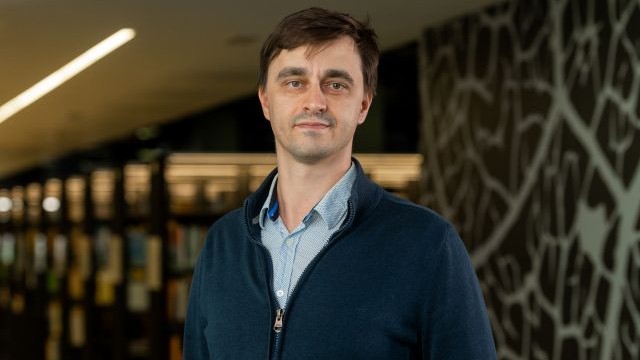
Juri Belikov

Juri Belikov received a BSc (cum laude) in mathematics from Tallinn University, and MSc and PhD degrees in computer and systems engineering from Tallinn University of Technology in 2006, 2008, and 2012, respectively. In the years 2015–2017 he was a Postdoctoral Fellow in the Faculty of Mechanical Engineering and The Andrew & Erna Viterbi Faculty of Electrical Engineering, Technion—Israel Institute of Technology. He is currently an Associate Professor in the Department of Software Science, Tallinn University of Technology. His main research interests lie on the edge of nonlinear control theory, power systems, and computer science.

Our research group is primarily focused on nonlinear control systems. Over the years, we have made significant contributions to the development of constructive algebraic methods that offer a unified approach to analyzing diverse challenges in nonlinear control. While our work is largely centered on general, application-independent methodologies grounded in the dynamic properties of mathematical models, we have recently begun targeting specific application domains such as robotic systems and smart buildings.

A growing area of emphasis is the study of real-world problems at the intersection of renewable energy integration and distributed energy storage in low-inertia power systems. Leveraging tools from optimal control theory, we aim to identify and overcome fundamental limitations in these emerging energy infrastructures.

In parallel, the group is increasingly integrating techniques from data science, machine learning, and energy informatics to enhance decision-making and system performance. We remain committed to advancing the role of information technology in the energy sector and promoting its widespread adoption for a more efficient, intelligent, and sustainable energy future.

Projects and applications

Centre of Excellence in Energy Efficiency
Team: Marika Eik, Svyatoslav Demin, Amna Rahmatullah, Juri Belikov, Kimia Soroush, Arvo Kaldmäe, Richa Verma, Margarita Matson, Abiodun Emmanuel Onile, Abiodun Emmanuel Onile, Orkhan Gahramanov, Maris Tõnso, Ülle Kotta, Azer Ramazanli, Hossein Nourollahi Hokmabad, Vadim Kaparin, Vejey Pradeep Suresh Achari
Year: 2024 - 2030
CoE ENER covers 53% of final energy use in Estonia as well as major energy saving measures with highest investment volumes. CoE aims to contribute to Estonian societal and economic challenge to transform 75% of existing building stock with poor energy performance to zero emission buildings (ZEB) with maximized co-benefits and improved life quality by 2050. The scientific aim is to extend the excellence in ZEB technologies to become the top research centre in equity-enhancing deep renovation, driving disruptive changes and initiating systemic reforms encompassing innovative technologies, novel governance models, novel participatory and collaborative approaches to engage citizens. Interdisciplinary CoE combines engineering, social, data sciences and economics with central focus on energy performance of buildings and districts, electrification and flexibility, renewable energy generation and storage, energy saving measures and business models with their socioeconomic and regional impacts.
Centre of Excellence in Energy Efficiency
Team: Hannaliis Jaadla, Veiko Lember, Dmitri Vinnikov, Eduard Petlenkov, Jarek Kurnitski, Targo Kalamees, Juri Belikov, Tiit Tammaru
Year: 2024 - 2030
CoE ENER covers 53% of final energy use in Estonia as well as major energy saving measures with highest investment volumes. CoE aims to contribute to Estonian societal and economic challenge to transform 75% of existing building stock with poor energy performance to zero emission buildings (ZEB) with maximized co-benefits and improved life quality by 2050. The scientific aim is to extend the excellence in ZEB technologies to become the top research centre in equity-enhancing deep renovation, driving disruptive changes and initiating systemic reforms encompassing innovative technologies, novel governance models, novel participatory and collaborative approaches to engage citizens. Interdisciplinary CoE combines engineering, social, data sciences and economics with central focus on energy performance of buildings and districts, electrification and flexibility, renewable energy generation and storage, energy saving measures and business models with their socioeconomic and regional impacts.
Refinement of oil shale into raw materials for industries
Team: Alar Konist, Juri Belikov, Kadriann Tamm, Ademola Michael Adegbile, Oliver Järvik, Dmitri Nešumajev, Mari Sinisalu, Gasham Hajiyev, Janek Reinik, Laura Kiolein, Peeter Somelar, Alejandro Lyons Ceron, Mai Uibu, Ahmad Mohammad Samih Taher Alomari, Kristel Tanilas, Janika Laht, Fanfan Xu, Mari-Liis Ummik, Hannela Artus, Dan Yang, Mais Hanna Suleiman Baqain
Year: 2024 - 2028
The project investigates and develops a chemical looping gasification (CLG) process as a novel CO2 capture technology for the upgrading of oil shale (OS) and biomass (including wood waste) into feedstocks for the chemical industry and construction materials in a waste-free and climate-neutral manner. The aim of the project is to produce gaseous products (mainly H2) for the chemical industry and solid mineral residue suitable for the cement industry, to ensure full utilization of OS. As a result of the project, the basic principles of CLG, the feasibility of simultaneous valorization of local resources, the optimal conditions and feedstock ratios to achieve the desired final product composition will be clarified. An important outcome of the project will be to ensure that the next generation of scientists and engineers are aware of the importance of local resources and their potential for environmentally friendly application.
Cyber-Physical systems and digital twins for the decarbonisation of energy-intensive industries
Team: Hossein Alimohammadi, Kristina Vassiljeva, Saleh Ragheb Saleh Alsaleh, Juri Belikov, Majid Ghorbani, Aleksei Tepljakov, Komeil Nosrati, Ahmet Köse, Eduard Petlenkov
Year: 2023 - 2027
Industrial production is responsible for roughly 30% of global energy use, with Energy Intensive Industries (EIIs) representing the largest share (54% of OECD’s total industrial energy consumption). The current energy crisis, originated by Russia’s war with Ukraine, Western sanctions against Moscow, and Russia’s cutoff of pipeline gas, has made the cost of natural gas soar and ignited a cascade resulting in the increased prices of other energy sources. As a learning for the future, it is crucial to strengthen the EU’s capacity to produce energy while reaching net-zero emissions by 2050. The solution lies in producing Renewable Synthetic Fuels (RSFs), including renewable hydrogen, from excess wind and solar power to decarbonise EIIs. Also, at the 26th UN Climate Change Conference of the Parties (COP26), it was unanimous that hydrogen can play a vital role in the way we bring fully decarbonised energy to our lives. However, a complete understanding of the impact of RSFs on EII systems remains unaddressed mainly due to a lack of comprehensive methods and specialised and multidisciplinary knowledge in RSFs’ combustion, which can be advanced through approaches bringing together data-driven methods and physics-based modelling for accurate simulation of combustion technologies through enhanced modelling, sensing and digital twins. The main aim of CYPHER is to propel the collaborations between European researchers and industrial stakeholders to foster the use of cyber-physical systems (self-updating digital twins) and ultimately promote a safe and sustainable adoption of RSFs as a critical path for EII decarbonisation.
ENFIELD: European Lighthouse to Manifest Trustworthy and Green AI
Team: Kristina Vassiljeva, Eduard Petlenkov, Ahmet Köse, Abiodun Emmanuel Onile, Komeil Nosrati, Aleksei Tepljakov, Hossein Alimohammadi, Majid Ghorbani, Azer Ramazanli, Saleh Ragheb Saleh Alsaleh, Juri Belikov
Year: 2023 - 2026
ENFIELD will create a unique European Centre of Excellence that excels the fundamental research in the scientific pillars of Adaptive, Green, Human-Centric, and Trustworthy AI that are new, strategic and of paramount importance to successful AI development, deployment, and acceptance in Europe and will further advance the research within verticals of healthcare, energy, manufacturing and space by attracting the best talents, technologies and resources from world-class research and industry players in Europe and by carrying out top-level research activities in synchronisation with industry challenges to reinforce a competitive EU position in AI and create significant socio-economic impact for the benefit of European citizens and businesses. ENFIELD will develop, maintain, scale-up and sustain a vibrant European network on AI composed of 30 consortium members from 18 countries, including top-level education and research organisations, large scale businesses, SMEs, and public sector representatives jointly addressing critical issues of research and innovation frontiers in this new topic of the European AI Lighthouse. ENFIELD will provide high impact outputs such as >75 unique AI solutions (algorithms, methods, simulations, services, data sets and prototypes), 180 scientific high-impact publications and 200 peer-reviewed presentations, four strategic documents, namely the Common Research Roadmap and Vision, the dynamic Safety and Security Risk Assessment Framework, the White Paper and the Gender and Ethics Framework. The exchange and innovation schemes planned in Open Calls, which will grant financial support to >76 individual researchers and 18 small-scale projects, education, and training activities such as summer schools and hackathons, and a set of well-designed outreach methods and activities will further contribute to the ENFIELD community engagement, enlargement, and continuity.
Otsid probleemile lahendust?